How to Write a Wedding Homily That Points Beyond the Couple to Christ
Asked to give a wedding homily? Here is a Scripture-first method for choosing a text, keeping it short, speaking to guests, and pointing the couple to Christ.
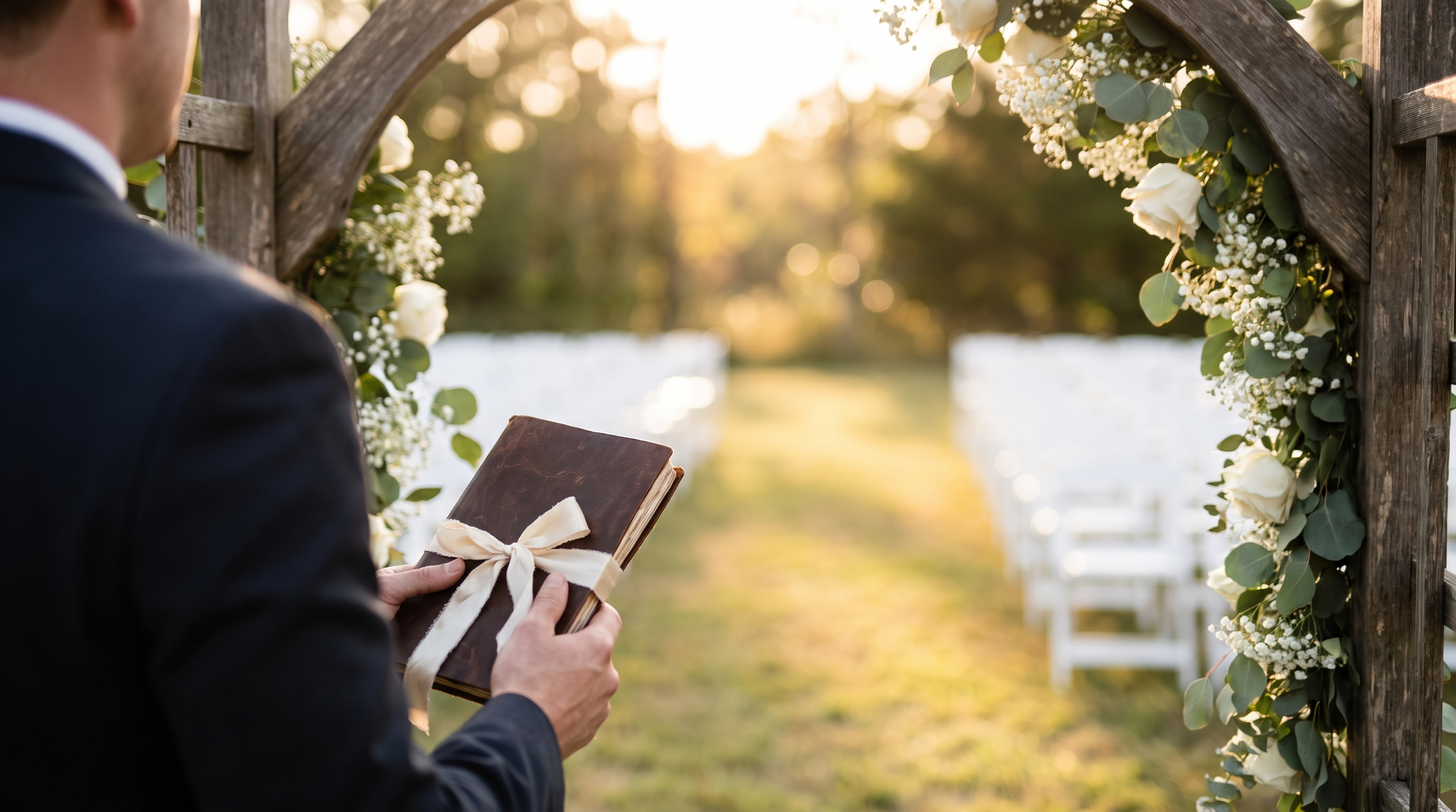
A wedding homily is one of the shortest messages a pastor will ever give, and one of the hardest to get right. You have eight to ten minutes. In front of you are two people who are barely hearing anything, two families with their own histories, and a room full of guests, many of whom have not been in a church in years. The temptation is to fill the time with advice, a few stories about the couple, and a closing line about love. That is a toast. A homily is something else.
A homily is a brief sermon. Its job is to open Scripture in a way that makes sense of the moment and points everyone present, the couple included, to Christ. This article walks through how to prepare one: choosing a text, letting it speak, structuring the message, and speaking to guests without preaching at them.
What a Wedding Homily Is (And Is Not)
It is not a marriage seminar. You cannot teach a couple how to handle money, conflict, and in-laws in eight minutes, and you should not try. That work belongs in premarital counseling. It is not a roast or a tribute. Stories about the couple can serve the message, but they are not the message. And it is not a full Sunday sermon delivered to a captive audience. Guests came for a wedding, and a message that ignores that will lose them.
What it is: a short, warm, clear opening of one passage of Scripture, applied to marriage, with a single charge to the couple and a single invitation to everyone else. If you keep that definition in front of you while you prepare, most of the decisions get easier.
Start With the Text, Not the Couple's Story
Many homilies go wrong at the start because you begin with what you want to say about the couple and then hunt for a verse to attach. Begin with the passage instead. Choose one, read it in its full context, and let it set the agenda.
Here are some of the passages most often used at weddings, each with a note on reading it well.
Genesis 2:18–25. The first marriage. "For this reason a man will leave his father and mother and be united to his wife, and they will become one flesh" (Genesis 2:24). Notice that the passage is about a need God identifies and meets. Marriage is presented as a gift before it is a duty.
Ephesians 5:22–33. Read it to the end. Verse 32 tells you what the whole passage is finally about: "This mystery is profound, but I am speaking about Christ and the church." Christian traditions read the instructions to husbands and wives with different emphases, so teach the passage the way your church teaches it, but do not miss that Paul himself says the deepest subject is Christ's love for His people.
Colossians 3:12–17. Not written about marriage, but about how believers treat one another: compassion, kindness, humility, gentleness, patience, forgiveness, and love as "the bond of perfect unity." It is a strong choice for a couple who will need to forgive each other often, which is every couple.
John 2:1–11. Jesus at a wedding in Cana, turning water into wine. The passage lets you say that Christ is not opposed to celebration; He blesses it, and He is the one who provides when the wine runs out.
Ecclesiastes 4:9–12. Two are better than one, and a cord of three strands is not quickly broken. Simple, memorable, and honest about hardship.
Revelation 19:6–9. The marriage supper of the Lamb. Every wedding on earth points to this one.
Choose one. If the couple has a passage they love, honor it if it fits; if it does not, gently suggest one that does. Then read the surrounding chapter, note what comes before and after, and write in one sentence what the passage is about in its own setting. Only then ask what it says to a wedding.
Let 1 Corinthians 13 Be About Christ First
The passage read at more weddings than any other deserves its own section, because it is also the one most often preached without its context.
"Love is patient, love is kind. It does not envy, it does not boast, it is not proud. It is not rude, it is not self-seeking, it is not easily angered, it keeps no account of wrongs. Love takes no pleasure in evil, but rejoices in the truth. It bears all things, believes all things, hopes all things, endures all things." (1 Corinthians 13:4–7, BSB)
Paul did not write this for a wedding. He wrote it to a divided church in Corinth that was proud of its spiritual gifts and unkind to one another. Chapter 12 is about the gifts; chapter 14 is about using them in order; chapter 13 sits between them to say that without love, none of it matters.
That context does not make the passage a poor choice for a wedding. It makes it a better one, because it gives you the honest thing to say: no couple can produce this love on their own. Read the list slowly and it describes a person, and the person it describes is Christ. He is patient. He keeps no account of wrongs. He bears all things. The charge to the couple is not "try harder to be like this." It is "receive this love from Him, and then give it to each other." As John writes, "We love because He first loved us" (1 John 4:19).
If you are preparing this passage, take the time to read chapters 12 through 14 in one sitting. Being able to click a verse in chapter 13 and ask how it connects to the argument on either side of it, and get an answer that stays within your church's teaching, is one of the ways www.gabrielchurchai.com can keep your preparation anchored in the text rather than in what you remember from the last wedding.
A Simple Structure That Holds
Here is a structure that fits in eight to ten minutes and keeps the homily from wandering.
1. Name the moment (about one minute). Say what is happening. Two people are making promises before God and witnesses. Acknowledge the families and the guests. Do not tell a long story here.
2. Read and open the passage (about three minutes). Read the text aloud, even if it was read earlier in the service. Then explain it briefly: what it meant to its first readers, and its main point in one sentence.
3. Show Christ in it (about two minutes). Every wedding text, read in the light of the whole Bible, points to Christ and His church. Say how. This is the center of the homily.
4. Turn to the couple with one charge (about two minutes). Speak to them by name. Give them one thing, drawn from the passage, to carry into their marriage. One. If you give them five, they will remember none.
5. Turn to the guests with one invitation (about one minute). The same Christ whose love this marriage is meant to reflect is offered to everyone in the room. Say it plainly, warmly, and briefly.
6. Bless and close. A sentence of blessing over the couple, and then step back into the vows or the rest of the service.
Write the whole thing out. A wedding is not the place to improvise; emotions run high, and a manuscript keeps you from rambling. Then cut it by a fifth. It will be better.
Speak to the Guests Without Preaching at Them
At most weddings, a large part of the room does not share the couple's faith. That is not a problem to be managed; it is an opportunity to be handled with care. A few principles help.
Assume nothing and explain briefly. If you say "the gospel," say in a sentence what you mean. If you mention Christ and the church, say what the church is. Guests are not offended by clarity; they are lost without it.
Be hospitable. You are, in a real sense, the host of a gathering that is taking place before God. Warmth in your tone communicates more than any argument.
Keep the invitation short and honest. You do not need to press for a response. You need to say, once and clearly, that the love this couple is promising each other has a source, and that the source is available to anyone who will come to Him.
Practical Matters
Length. Eight to ten minutes. If you run longer, the couple will not remember more; they will only remember that it was long.
Personal detail. Include enough that the couple knows the homily was written for them: how they met, something you noticed in counseling, a trait each has that will serve the other. Keep it to a few sentences and keep it kind. Never make a joke at either person's expense.
Your own marriage. Use it sparingly, if at all. The couple's day should not become a story about yours.
Rehearse aloud. Time it. Mark the places where you need to slow down. Look up from the page at the couple during the charge.
Keep what you write. Pastors officiate many weddings over a lifetime, and the passages repeat. A homily on Colossians 3 that you wrote carefully this year should be findable next year, not lost in a folder on a laptop that has since been replaced. Churches that keep their sermons, homilies, and service outlines in a shared, searchable space, like the organizational knowledge base at www.gabrielchurchai.com, save every staff member from starting over, and let an associate pastor learn from a senior pastor's twenty years of weddings.
Prepare It This Week
If you have a wedding coming, here is the work for this week. Choose the passage and read its full context. Write the main point in one sentence. Draft the six movements above. Cut the draft by a fifth. Read it aloud and time it. Then pray for the couple by name.
If you want help getting from a blank page to a first draft, you can describe the passage, the couple, and the occasion, and let the sermon builder at www.gabrielchurchai.com produce an outline shaped to your church's teaching, which you then revise in your own voice. The draft is a starting point; the text and your pastoral judgment are what carry it. Start a free trial, open the passage the couple has chosen, and begin there.