How to Write a Communion Meditation That Points People to Christ
A communion meditation should be short, Scripture-anchored, and Christ-centered. Here is a simple way to prepare one that helps a congregation remember well.
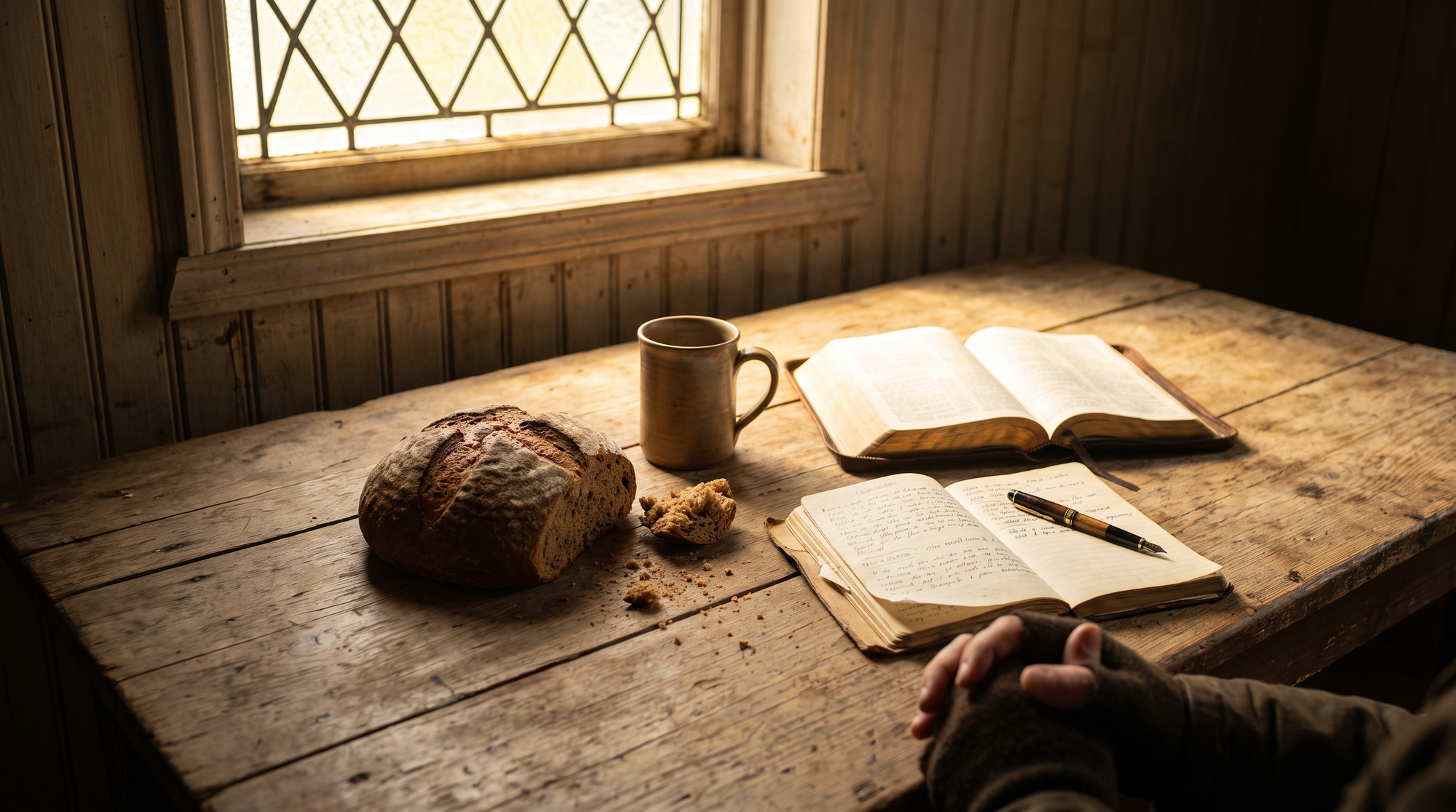
In many churches, someone stands up before the bread and cup and offers a few words. Sometimes it is the pastor. Often it is an elder, a deacon, or a lay leader who was asked on Tuesday and has been quietly worried about it ever since.
The communion meditation is one of the most important short pieces of speaking in the life of a church, and one of the least prepared. It is easy to fill the moment with a vague reflection on gratitude, or a rushed reading of 1 Corinthians 11 with no explanation, or, at the other extreme, a second sermon. None of those serve the table well.
What follows is a practical way to write a communion meditation that is brief, rooted in Scripture, and centered on Christ. It works whether you have a week to prepare or an evening.
Know What the Meditation Is For
Before you write anything, be clear about the purpose. The communion meditation is not the sermon, and it is not a devotional about your week. It exists to help the congregation do what Jesus asked: to remember Him.
"For I received from the Lord what I also delivered to you, that the Lord Jesus on the night when he was betrayed took bread, and when he had given thanks, he broke it, and said, 'This is my body, which is for you. Do this in remembrance of me.' In the same way also he took the cup, after supper, saying, 'This cup is the new covenant in my blood. Do this, as often as you drink it, in remembrance of me.' For as often as you eat this bread and drink the cup, you proclaim the Lord's death until he comes." (1 Corinthians 11:23–26, ESV)
Three things stand out in that passage, and a good meditation will usually touch at least one of them. The table is about remembrance (looking back at the cross). It is about covenant (what Christ's death secured for His people). And it is about proclamation and hope (announcing His death "until he comes"). If your meditation helps people see Christ more clearly in one of those three directions, it has done its job.
Churches differ on how they understand the Supper, and this article does not settle that. Whatever your tradition teaches about the bread and cup, the meditation should serve that teaching, not blur it. If you are unsure how your church frames the table, ask your pastor before you write.
Choose One Passage, Not Five
The most common mistake in a communion meditation is trying to say too much. Choose one passage of Scripture and let it carry the moment.
Good options include the institution narratives (Matthew 26:26–29, Mark 14:22–25, Luke 22:14–20), Paul's account in 1 Corinthians 11, the Passover in Exodus 12, the Suffering Servant in Isaiah 53, the bread of life discourse in John 6, or the wedding supper of the Lamb in Revelation 19. There are many more. The point is to pick one and stay there.
When you have chosen a passage, read it slowly several times. Ask what it says about Christ's body, His blood, His covenant, or His return. Write down one sentence that captures the heart of it. That sentence becomes the spine of your meditation.
This is where good study tools earn their place. If you are working through Exodus 12, for example, being able to read the passage in a couple of translations side by side, and then ask a question about how the Passover lamb is connected to Christ in the New Testament, can sharpen your one sentence considerably. The Bible reader at www.gabrielchurchai.com lets you do that without leaving the text, and the answers stay within the bounds of your church's tradition rather than pulling you somewhere you did not intend to go.
Build It in Four Short Parts
A communion meditation usually runs two to four minutes. A simple structure keeps it disciplined.
1. Open with the text. Read the passage, or the key verses from it. Let Scripture speak first. Do not introduce it with a story about yourself.
2. Explain one thing. In three or four sentences, explain what the passage shows about Christ. Not everything it could show. One thing. If your passage is Isaiah 53, that might be: "He was pierced for our transgressions. The bread we break reminds us that the wounds were real, and they were for us."
3. Connect it to the table. Say plainly how this truth meets us in the bread and cup. This is where you move from "what the text says" to "why we are doing this now." Keep the focus on what Christ has done, not on how the congregation should feel.
4. Invite people to come. Close with a short sentence that turns hearts toward Christ and hands toward the elements. A line of Scripture often works well here: "Come, everything is ready," or "Taste and see that the Lord is good."
Write all four parts out in full. Even experienced speakers benefit from a script for the table, because the temptation to wander is strongest when the moment feels sacred and unscripted.
Keep It Christ-Centered, Not Guilt-Centered
Paul does call the church to examine itself before eating and drinking (1 Corinthians 11:28). Self-examination belongs at the table. But a meditation that dwells only on unworthiness can leave people staring at their sin rather than their Savior.
The historic pattern of the church is to hold both together: honest confession, and confident assurance. If you name sin, name grace more loudly. If you speak of the cost, speak of the One who paid it. The bread is broken for you. The cup is the new covenant in His blood. People should walk to the table looking at Christ.
A practical check: read your draft and count how many sentences are about the congregation and how many are about Jesus. If the balance tips toward the congregation, revise.
Write for the Ear, Not the Page
A meditation is spoken, so it should sound like speech. Use short sentences. Avoid stacked clauses. Say "He died for us," not "The atoning work accomplished at Calvary was efficacious on our behalf."
Read your draft aloud at least twice. Time it. If it runs past four minutes, cut. It is far better to say one true thing clearly than three true things hurriedly.
If you find that your draft is still too long or too dense, it can help to have a second set of eyes on it. Some leaders use a tool to tighten what they have written, asking it to shorten a paragraph or suggest a clearer transition while keeping the Scripture and the point intact. At www.gabrielchurchai.com you can paste your draft alongside your passage and refine it without the tool rewriting your theology. The words should remain yours; the tool simply helps you say them more plainly.
A Worked Example
Here is a complete meditation built on Exodus 12, to show the shape. It runs about two and a half minutes aloud.
"In Exodus 12, the Lord tells Israel to take a lamb without blemish, to kill it at twilight, and to put its blood on the doorposts of their houses. 'When I see the blood,' He says, 'I will pass over you.'
"That night, judgment fell on Egypt. But in every house marked by the blood, there was life. Not because the people inside were better than their neighbors. Only because of the lamb.
"Centuries later, John the Baptist saw Jesus and said, 'Behold, the Lamb of God, who takes away the sin of the world.' And on the night of Passover, Jesus took bread and a cup and said, 'This is my body. This is my blood of the covenant.' He is the Lamb. The blood is His. And it is on the door of every one who trusts Him.
"When you take this bread, remember that the Lamb was without blemish, and He was slain for you. When you drink this cup, remember that judgment has passed over you, forever, because of His blood.
"Come. Everything is ready."
Notice what it does not do. It does not tell a personal story. It does not try to cover the whole doctrine of the atonement. It does not lecture. It reads the text, explains one thing, connects it to the table, and invites people to come.
Prepare a Set, Not Just One
If your church takes communion weekly or monthly, the same few passages will come around often. Consider writing a small collection of meditations over a season, each built on a different text: one from the Gospels, one from Paul, one from the Old Testament, one from Revelation. Keep them in one place so that whoever is asked to speak on Tuesday is not starting from nothing.
For churches that want to share that work across a team, a shared library at www.gabrielchurchai.com lets elders and lay leaders draw from the same set of prepared meditations, adapt them, and keep the church's voice consistent at the table over time.
The Goal Is Remembrance
A communion meditation is not a performance and it is not a formality. It is a few minutes in which the church is helped to remember Christ crucified and risen, and to look forward to the day He returns. That is worth preparing for.
Choose one passage. Explain one thing. Point people to Jesus. Then step back and let the bread and cup do what He gave them to do.
If you would like help preparing your next meditation, or a full set for the season ahead, you can start a free trial at www.gabrielchurchai.com and begin with the passage your church will read this Sunday.