How to Turn Sunday's Sermon Into a Week of Family Devotions
Your pastor already did the hard work. Here is a repeatable five-day structure for turning Sunday's sermon passage into family devotions all week long.
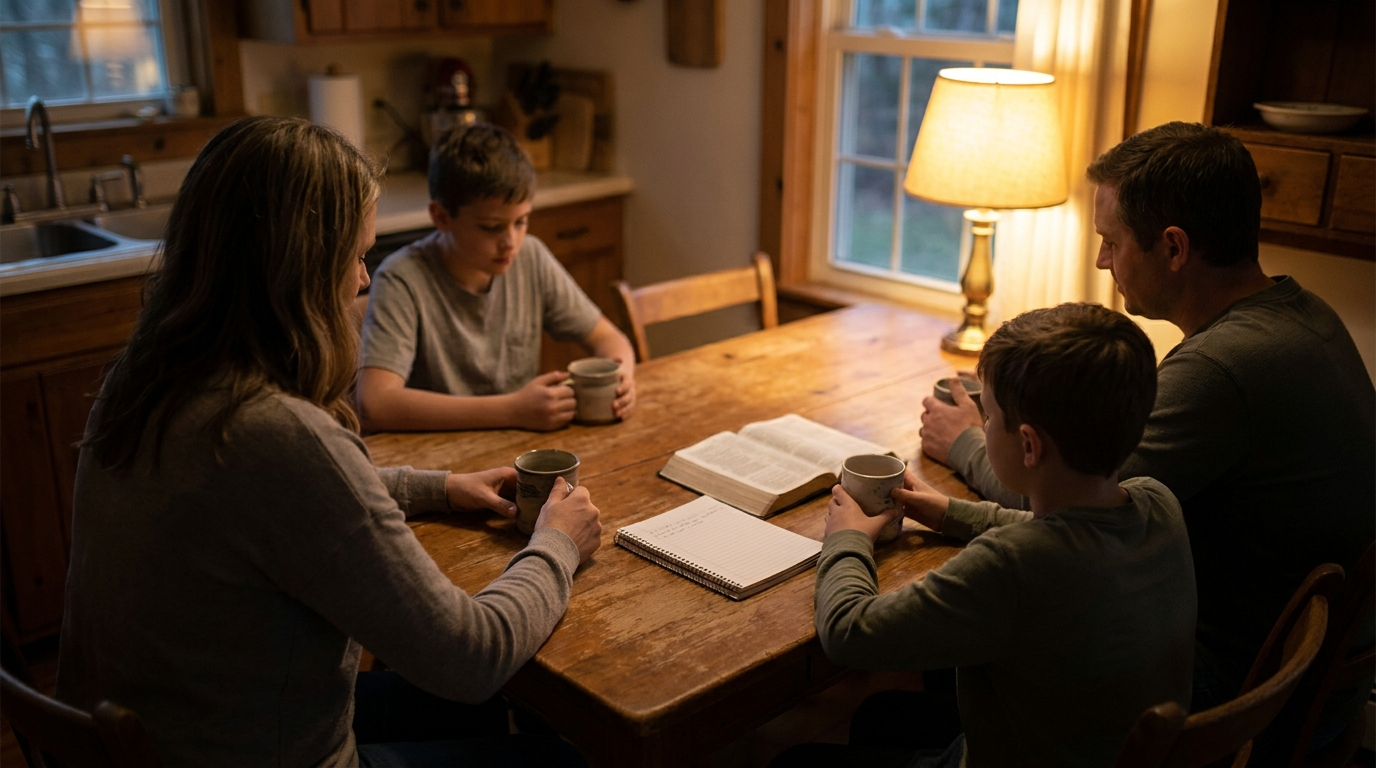
Sunday morning, your pastor spends thirty-five minutes carefully working through a passage. By Tuesday, most of it is gone. Not because the teaching was weak, but because a sermon heard once is an event, and formation happens through repetition.
Meanwhile, many families want to do something together around Scripture during the week and never get past the intention. The obstacle is almost never willingness. It is the blank page. Deciding what to study, finding something age-appropriate, and preparing it well enough to lead is real work, and it competes with everything else in a weeknight.
There is an obvious solution sitting in plain sight. Your church has already done the hardest part of that work. Someone has already chosen the passage, studied the context, and identified what matters in it. Turning that into a week of family devotions is not a new project — it is an extension of one already finished.
Why Reinforcing the Sermon Works
Three things happen when a family spends the week in the passage they heard on Sunday.
Repetition does what a single hearing cannot. The passage gets encountered five or six times instead of once, in different forms, with different questions attached. That is how text moves from something you heard to something you know.
Children begin to see church and home as one thing. When the passage from Sunday shows up at the dinner table on Wednesday, the implicit message is that this is not a compartment. It is the family's actual subject matter.
Sunday changes. A family that has spent the week in Ephesians 4 listens to a sermon on Ephesians 5 differently. They arrive with context and questions rather than starting cold.
The pattern itself is ancient. Israel was given instructions about exactly this:
"And these words, which I command thee this day, shall be in thine heart: and thou shalt teach them diligently unto thy children, and shalt talk of them when thou sittest in thine house, and when thou walkest by the way, and when thou liest down, and when thou risest up." (Deuteronomy 6:6-7, KJV)
Note the settings: sitting at home, walking on the road, lying down, getting up. Not a formal teaching hour. The ordinary shape of a day. Whatever you build should fit that description, or it will not last past the second week.
A Five-Day Structure You Can Reuse Every Week
The goal is a repeatable frame you fill with new content each week, not a fresh design every Monday. Here is a structure that holds up across passages and age ranges.
Day One: Read the Passage Together
No teaching. No discussion questions. Just read the sermon passage aloud, slowly, and stop. If the passage is long, read the central section.
The only prompt: "What did you notice?" Let the answers be whatever they are. A four-year-old noticing that someone was in a boat is a legitimate observation. Resist the urge to correct or redirect. You are establishing that the text comes first.
Five minutes is enough.
Day Two: One Question About the Text
Pick a single question that requires looking back at the passage to answer. Not "what does this mean to you" — something with an actual answer located in the words.
For a passage about the paralyzed man lowered through the roof: what did the friends have to do to get him there? What did Jesus say first, before He said anything about walking? Why do you think that order matters?
This is the day that teaches your children how to read, not just what to believe.
Day Three: Connect It Backward
Find one place elsewhere in Scripture that the passage touches. A quotation, an echo, a promise it fulfills, a pattern it repeats. Read both, side by side.
This is the day that most often stalls a well-meaning parent, because it requires knowing the canon well enough to find the connection. It is also the day with the highest payoff, because it is where children learn that the Bible is one book rather than sixty-six unrelated ones.
It is worth saying plainly that this is a research problem, not a spiritual one. When you are looking at Mark 2 and want to know what the crowd would have heard in "your sins are forgiven," being able to ask that question directly at the verse — and get an answer that follows your own church's theological framework rather than a flattened average of everyone's — collapses an hour of work into a few minutes. That is the specific reason verse-level study inside www.gabrielchurchai.com is anchored to a denominational tradition rather than offering one generic answer to everyone.
Day Four: Application, Named Specifically
Vague application produces nothing. "Be more loving this week" is not a plan. Push toward something concrete enough to be checked.
Ask each person to name one thing this passage asks of them between now and Sunday. Write them down. Parents answer too, and answer honestly — children learn considerably more from watching a parent take Scripture seriously than from being told to.
Day Five: Pray the Passage
Turn the text itself into prayer. If the passage is about God's provision, thank Him for specific provision. If it is a command, ask for help obeying it. If it is a promise, ask for faith to believe it.
This trains something valuable: prayer shaped by Scripture rather than by whatever happens to be on the surface of our minds. Children who learn to pray from the text will keep doing it for decades.
Adjusting for the Ages at Your Table
Most families are not working with one age group. A few adjustments cover the spread.
Under seven: Shorten everything. Ask them to retell the passage in their own words rather than answer questions about it. Retelling is comprehension, and it is developmentally the right target.
Seven to eleven: This is the age for the "why" questions. Why did he do that? Why is this here? They can handle real complexity and will notice inconsistencies faster than adults expect.
Twelve and up: Give them something to disagree with. Teenagers who are only ever handed conclusions stop engaging. Let them push on the hard parts of the passage, and do not pretend the hard parts are simple.
Mixed ages: Direct specific questions to specific people rather than opening every question to the room. Otherwise the oldest child answers everything and the youngest stops trying.
Getting the Content Without the Prep
The structure above takes about twenty minutes to fill in for a given week — if you know the passage well. If you do not, it takes considerably longer, and that gap is where most family devotion plans die.
A few things reduce the load meaningfully.
Ask your pastor for the passage in advance. Many preach through books and can tell you the next month's texts. Knowing Sunday's passage on the previous Monday changes everything about your preparation.
Prepare the whole week at once. Sunday afternoon, while the sermon is fresh, sit down and fill in the five days. One sitting, five days of content. Trying to prepare each evening as it arrives is how the plan collapses by Wednesday.
Generate the frame, then edit it. Producing a structured five-day guide from a passage is exactly the kind of task worth handing to a tool — and then reviewing carefully against the text yourself. What comes back is a draft, not an authority. You are the one who knows your children, and Scripture is the one that settles what is true. Being able to generate a study plan from a passage, then adapt it for the ages at your table, is one of the more practical uses of what we built at www.gabrielchurchai.com.
Keep last year's work. Churches cycle through books. The guide you build for Colossians this year is a starting point when your church returns to it, and your children will be old enough for different questions by then.
Two Honest Cautions
Do not let the guide become the point. If a genuine question comes up on Day Two that takes the whole week, follow it. The structure exists to prevent blank-page paralysis, not to be completed. A family that spent five days on one question a child actually cared about did better than a family that checked all five boxes.
Do not treat the sermon as the text. The passage is Scripture. The sermon is a faithful human attempt to explain it. Build your week around the passage and let the sermon serve as a guide to it. This distinction matters more than it might seem — it teaches your children where authority actually rests.
Start This Sunday
You do not need a curriculum, a subscription to a children's ministry program, or a theology degree. You need this Sunday's passage, five short evenings, and a willingness to be the person who says "I do not know, let us find out" when a child asks something hard.
Begin with the coming week. Write down the passage on Sunday afternoon. Fill in the five days. Keep it to ten minutes a night. Do it for four weeks before deciding whether it is working, because the first two weeks of anything feel awkward.
If you want a place where the passage, the plan you build from it, and the questions your family raises all stay in one place — and where the whole family can work from a shared study environment — you can start a free trial at www.gabrielchurchai.com. Take this Sunday's text and build the first week.