How to Lead a Bible Study When Half Your Group Is New to Scripture
Leading a group where half are new to Scripture? A three-layer structure that keeps experienced members engaged without losing anyone who just started.
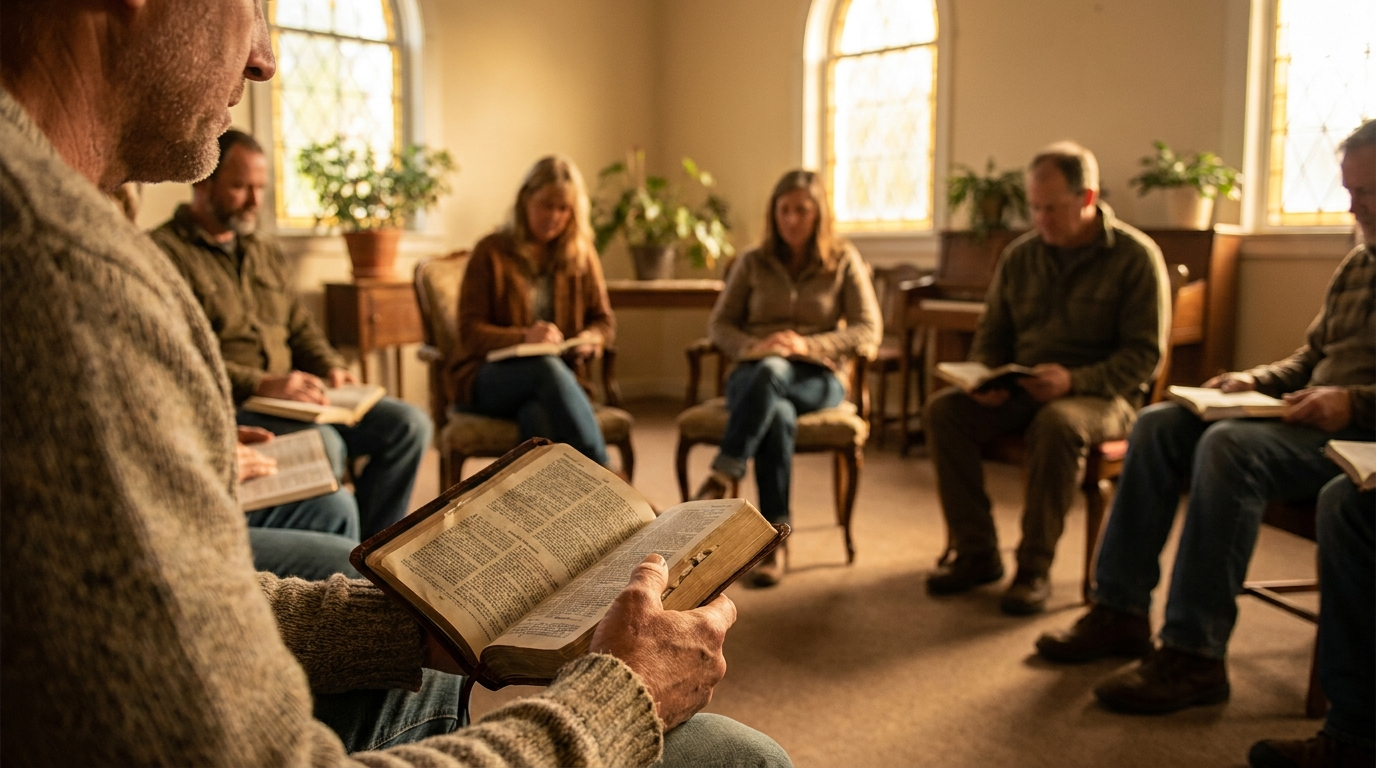
You look around the circle and realize you are leading two groups at once. Half the people have been reading Scripture for twenty years and can find Habakkuk without the table of contents. The other half opened a Bible for the first time last month and are quietly hoping nobody asks them to read aloud.
Most group leaders handle this by picking a lane. Either they teach to the experienced half and lose the newcomers, or they simplify everything and lose the people who came for depth. Both choices cost you half the room.
There is a third option, and it is better than a compromise. A mixed-experience group can be more formative than a uniform one — for both halves — if you structure it deliberately. The people who are new bring questions the experienced have stopped asking. The experienced bring context the new ones cannot yet supply. That exchange is worth building for.
Name the Situation Out Loud
Start here, in the first meeting, plainly: "Some of you have read this book many times. Some of you are new to it. Both of those are fine, and we are going to work in a way that fits both."
This does more than set expectations. It removes the pretending. Newcomers who think everyone else already knows everything stay silent to avoid exposure. Experienced members who think they are supposed to be the resident expert start performing. Naming the mix defuses both.
Then add the sentence that actually changes the room: "The best question in here is usually the one someone is embarrassed to ask." Say it and then prove it by treating basic questions as genuinely useful when they come — because they are. "Who is Paul writing to?" is a better opening question than most study guides produce.
Choose Material That Works at Two Depths
Some books are considerably friendlier to mixed groups than others. Not because they are shallow, but because they are accessible on the surface while still rewarding careful work.
Strong choices: Mark, for its pace and concreteness. Philippians, short and warm and structurally clear. James, practical from the first reading. Genesis 1–12, foundational for everything that follows. Ruth, a complete story in four chapters.
Harder choices for a mixed group: Romans, Hebrews, Revelation, Leviticus. Not because newcomers cannot handle them, but because they require so much background that you will spend most of your time on prerequisites, and the experienced half will get restless.
Whatever you choose, work through a book rather than hopping topics. A book gives newcomers something they badly need: continuity. Each week builds on the last, and by week six they have context they did not have to be given — they earned it by reading.
The Structure That Holds Both Halves
Run each meeting in three layers, in this order.
Layer One: Observation (everybody, ten minutes)
Read the passage aloud and ask only what the text says. Who is speaking. What happens. What words repeat. What is surprising.
This layer is genuinely level. A person reading Mark for the first time can notice that Jesus keeps telling people not to tell anyone, and that observation is just as valid coming from them as from a twenty-year reader. In fact the newcomer often notices it more readily, because familiarity dulls surprise.
Do not let anyone jump to interpretation here. When someone does — and the experienced members will — say something like "hold that, we will get there, but first let us make sure we all see what is on the page."
Layer Two: Interpretation (twenty-five minutes)
Now ask what it means. This is where the two halves have different needs, and where directed questions matter.
Do not open every question to the room. Aim specific questions at specific people, chosen to fit what they can offer:
- To a newer member: "When you read that, what confused you?" This is a question they are uniquely positioned to answer, and their confusion usually marks a genuine difficulty in the text.
- To an experienced member: "Where else does Scripture say something like this?" This uses what they have without turning them into the teacher.
- To the room: "What would this have meant to the people who first heard it?" Nobody has an automatic advantage here, which is exactly why it works.
You will hit questions you cannot answer. Say so, and say it without apology: "I do not know. Let me look into it and bring it back next week." A leader who admits the limit of their knowledge teaches the group more about intellectual honesty than a leader who improvises an answer.
Then actually bring it back. This is where preparation between meetings pays off, and where having a way to work through a specific question at the verse level — rather than searching the open internet and sorting through material from a dozen different theological traditions — saves real time. Study that stays aligned to your own church's framework is one of the reasons www.gabrielchurchai.com asks about your tradition up front rather than handing everyone the same answer.
Layer Three: Application (fifteen minutes)
Both halves are on equal footing again. A person three weeks into faith and a person thirty years in are both being asked what this passage requires of them, and neither has an advantage.
Keep it concrete. "Be more patient" is not an application. "I am going to have the conversation with my brother that I have been avoiding for two months" is.
Handling the Two Failure Modes
Mixed groups fail in two predictable directions. Both are manageable if you see them coming.
The experienced member who answers everything
Usually well-intentioned. They know the material, they want to help, and silence makes them uncomfortable. But every question they answer immediately is a question a newcomer did not get to attempt.
Handle it by assignment rather than correction. Give them a specific role: "Would you track down what Isaiah 53 has to say about this and bring it next week?" You are honoring their knowledge and reducing their airtime at the same time. If it persists, a private conversation works better than a public one: "I need your help drawing out the newer folks. Would you hold your answers for a beat and see who else speaks?"
The newcomer who never speaks
Often it is not shyness. It is a reasonable calculation that they have nothing to contribute yet.
Change the calculation. Ask them questions only they can answer — about their confusion, their reaction, what struck them as strange. Never put them on the spot to read aloud or locate a reference without warning; both are small humiliations for someone unfamiliar with the book. And give the group a shared page reference every time: "Page 812 in the pew Bible, or just search for Mark 2." That single habit removes a surprising amount of anxiety.
The Between-Meetings Work That Makes This Sustainable
Leading a mixed group takes more preparation than leading a uniform one, because you are preparing for two levels of question. A few things reduce the load.
Write your questions in advance, tagged by who they are for. Not a script — a list of eight to ten questions where you have already noted which ones are for newer members and which draw on background. In the moment, this is the difference between a group that flows and one that stalls.
Prepare a short context note for each session. Three or four sentences on who wrote this, to whom, and what has happened in the book so far. Read it at the top. It costs ninety seconds and it puts everyone on the same footing for the next hour.
Keep a running list of unanswered questions. Some resolve as the group reads further. Some need real research. Either way, the list becomes a record of what your group is actually wrestling with, which is better information about their spiritual state than anything they would tell you directly.
Build your guides once and adapt them. If you can generate a set of discussion questions from a passage, then edit them for the specific people in your circle, you have cut the largest piece of your preparation without outsourcing the discernment. The generated draft is raw material. You are still the one who knows that Marcus is three weeks in and that Diane has been asking about suffering since March. Being able to produce a small group guide from a passage and then shape it for your group is a common workflow inside www.gabrielchurchai.com, and the shaping is the part that cannot be automated.
What You Are Actually Building
It is worth being clear about the goal. You are not trying to get the newcomers caught up to the experienced members. You are building a group where people at different places are genuinely useful to each other.
Paul describes something like this when writing about the body:
"For as the body is one, and hath many members, and all the members of that one body, being many, are one body: so also is Christ. ... And the eye cannot say unto the hand, I have no need of thee: nor again the head to the feet, I have no need of you." (1 Corinthians 12:12, 21, KJV)
The experienced member needs the newcomer's questions. That is not a nice sentiment — it is structurally true. Long familiarity with a text produces a kind of blindness that only fresh eyes correct. The newcomer needs the experienced member's context, and the experienced member needs the newcomer's willingness to ask why.
A group where both are talking is not a group with a problem to solve. It is a group working the way it should.
Your Next Meeting
Three changes to try this week. Name the mix out loud at the start. Run the three layers in order and refuse to let interpretation start before observation finishes. Direct at least three questions to specific people rather than to the room.
That is enough to change the dynamic in a single meeting. The rest is repetition.
If you want a place to prepare — where you can work through a passage, build questions for your specific group, and keep track of what everyone is asking week to week — you can start a free trial at www.gabrielchurchai.com. Open your next passage and start with the observation layer.