How to Equip Your Worship Team to Choose Songs Rooted in Scripture
Your congregation learns theology from what it sings. Here is a simple four-question framework to help your worship team choose songs grounded in Scripture.
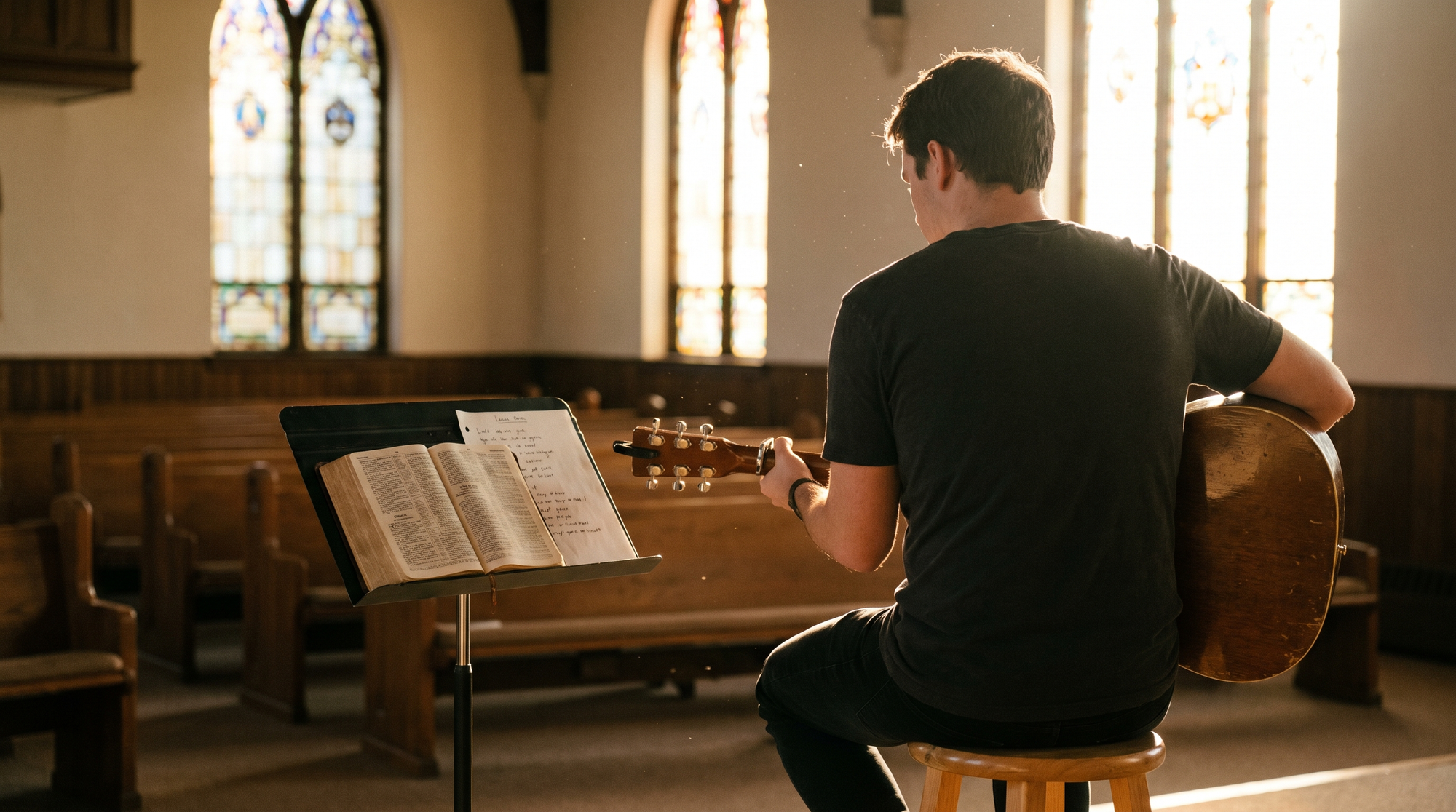
Most churches spend more time each week singing Scripture-shaped words than reading Scripture aloud. Four or five songs, each sung by the whole room, each repeated week after week. Over a year, those lyrics do more to form what a congregation believes about God than almost any other single input. That is not a criticism of music. It is a reason to take song selection seriously.
Yet in many churches, the worship team chooses songs by feel. Is it singable? Does it fit the tempo of the set? Did it go well last time? Those are fair questions. But they are not the first question. The first question is whether the song says something true about God, and whether the people singing it will be more grounded in Scripture because they sang it.
This post is for pastors and worship leaders who want to equip their team to choose songs with Scripture in view, without turning every planning meeting into a theology exam.
Why Song Selection Is a Teaching Responsibility
Paul makes the connection between singing and teaching explicit. Writing to the church in Colossae, he says:
"Let the word of Christ dwell in you richly in all wisdom; teaching and admonishing one another in psalms and hymns and spiritual songs, singing with grace in your hearts to the Lord." (Colossians 3:16, KJV)
Notice the order. The word of Christ dwells in the people first, and the singing flows out of that. And notice the function: the songs are a means of teaching and admonishing one another. Singing, in Paul's mind, is not a warm-up for the sermon. It is one of the ways the congregation instructs itself.
That means whoever picks the songs is, in a real sense, choosing a portion of the church's curriculum. A worship leader may never stand behind a pulpit, but the words they put on the screen will be repeated, memorized, and carried into hospital rooms and kitchen tables for years. Equipping a team to handle that responsibility well is pastoral work.
The Problem Is Rarely Bad Songs. It Is Untested Songs.
Few worship teams knowingly choose songs that contradict Scripture. The more common issue is that songs simply go untested. A song sounds beautiful, it is popular, the band already knows it, and it goes on the list. Nobody asks what it actually claims.
Some of the questions that get skipped:
Does the song describe God accurately, or does it describe a feeling about God? Is Jesus named, or could the lyrics be sung to anyone? Does the song make a promise Scripture makes, or a promise Scripture never made? Are the lines drawn from a passage, and if so, does the song use that passage the way the passage uses itself?
None of those questions require a seminary degree. They require a habit of checking, and a team that knows checking is expected.
A Simple Framework Your Team Can Actually Use
Below is a four-part filter that a worship team can apply to any song in a few minutes. It works best when the whole team learns it together, so that "Does this pass the filter?" becomes normal language in planning conversations.
1. What does this song say about God?
Write down, in plain sentences, the claims the song makes. "God is faithful." "Jesus rose from the dead." "God will give me what I want." Strip out the melody and look at the sentences. If a claim sounds off when spoken plainly, it is off when sung.
2. Where does Scripture say that?
For each major claim, find a passage. Not a vibe, a passage. If the song says God is a refuge, Psalm 46 is right there. If the song says Christ bore our sins, 1 Peter 2:24 is right there. If you cannot find where Scripture says it, that is worth pausing on. It may still be a sound inference, but the team should know it is an inference.
This is where the work can bog down, especially for volunteers who did not grow up with Bible references at their fingertips. It helps to have a tool that lets a team member paste a lyric and ask, plainly, "Which passages does this line echo, and does the song use them faithfully?" Inside www.gabrielchurchai.com, that kind of question can be asked directly against the biblical text, and because Gabriel responds within your church's own theological tradition, the answer will not quietly pull your team toward a framework your church does not hold. The goal is not for the tool to approve the song. The goal is for it to put the relevant Scripture in front of a volunteer quickly, so the team makes the call with the text open.
3. Does the song fit what we are teaching?
A song can be true and still be out of place. If the sermon is on repentance and every song is about victory, the service works against itself. Worship teams that see the preaching calendar ahead of time can select songs that reinforce the passage instead of competing with it. This is a coordination problem more than a theological one, and it is solved by sharing information early.
4. Can our people sing this honestly?
Some songs make declarations that are true of the mature believer but not yet true of the newcomer in the back row. "I surrender all" is a wonderful aspiration; it is not always an honest description. Scripture itself gives us songs of lament, confession, and waiting, not only songs of triumph. A congregation needs the full range. Equipping a team to notice when a set is all one emotional register is part of choosing well.
Training the Team Without Overwhelming Them
Here is a practical way to introduce this framework over a month, with one short session per week.
Week one: Colossians 3:16 and Ephesians 5:19. Read the passages together. Talk about singing as teaching. Ask the team what songs have shaped their own understanding of God. This grounds the framework in Scripture rather than in a pastor's preference.
Week two: Test a familiar song. Take a song the church already sings and loves. Walk it through the four questions together. Find the passages. The point is not to catch the song failing; the point is to practice the habit on something safe.
Week three: Test a new song. Bring a song someone on the team wants to introduce. Apply the filter. Let the team reach a conclusion together. If it passes, add it. If it needs a verse dropped or a line clarified, discuss that openly.
Week four: Build the reference sheet. For every song in your regular rotation, record the two or three key passages it draws from. This becomes a living document the team can add to. A pastor can generate a first draft quickly by asking Gabriel to map each song's main claims to Scripture, then having the team review and correct it. Over time this sheet becomes one of the most useful discipleship resources the worship ministry owns, because it turns every song into a doorway into the Bible.
What This Looks Like on a Sunday
Imagine a worship leader who, before rehearsal, opens the sermon passage for the week and reads it. She notices the sermon is on Psalm 23. She checks the rotation sheet and sees three songs that draw from that psalm, plus one that draws from John 10 on the Good Shepherd. She builds a set that carries the congregation from the psalm into the gospel. When she introduces the second song, she says one sentence: "This song comes from the same psalm Pastor will preach on this morning."
Nothing in that scenario is complicated. But the congregation walks out having heard Psalm 23 sung, read, preached, and connected to Christ. That is what it means to let the word of Christ dwell richly.
A Word About Tools and Authority
It is worth saying clearly: no software should decide what your church sings. Scripture is the standard, and the elders and leaders God has placed over the congregation are the ones responsible for what gets taught, whether it is taught from a pulpit or a screen. A tool like Gabriel is useful because it makes the Scripture-checking step faster and more accessible to volunteers who might otherwise skip it. It is not useful if it becomes the referee.
Used rightly, the workflow is simple. A team member has a question about a lyric. They ask it, with the Bible open, inside www.gabrielchurchai.com. They get the passages and a clear explanation shaped by your tradition. They bring that to the team. The team, under pastoral oversight, decides. The tool served the Word, not the other way around.
Start With One Song
If your worship team has never thought about song selection this way, do not try to overhaul the whole catalog in a week. Pick one song this Sunday. Run it through the four questions. Find the passages. Talk about it at rehearsal. Then do it again next week.
Small, consistent habits are how teams change. And a worship team that has learned to keep Scripture open while it plans will quietly raise the biblical literacy of the entire congregation, one song at a time.
If you would like to see how Gabriel can help your team check lyrics against Scripture, build a song reference sheet, and stay aligned with your church's theology, you can start a free trial today at www.gabrielchurchai.com.