How to Create a Family Devotional Plan for Busy Weeknights
Deuteronomy 6 offers a realistic model for family devotions. Here's how to build a short, weeknight-proof plan that actually lasts past January.
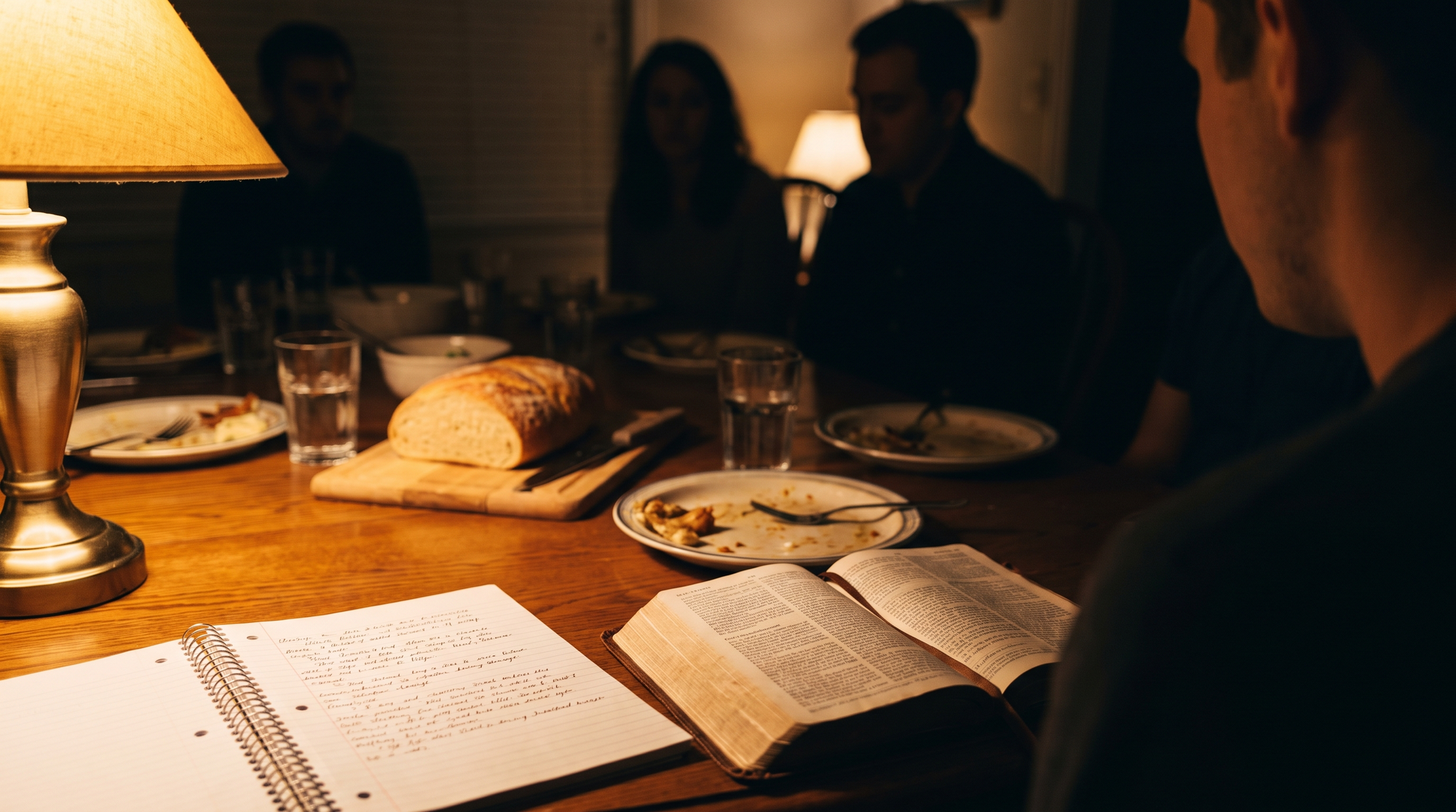
Most families do not abandon devotions because they stop caring. They abandon them because the plan they started with assumed an evening they do not actually have: everyone calm, unhurried, and ready to sit still for twenty minutes. Deuteronomy 6 offers a far more realistic model, and building a family devotional plan around it, rather than around an idealized evening, is usually the difference between a habit that lasts and one that quietly disappears by February.
The Model Is Deuteronomy 6, Not a Perfect Evening
Moses gives Israel's parents a specific instruction for passing on faith to their children, and it is worth reading in full:
"And these words, which I command thee this day, shall be in thine heart: And thou shalt teach them diligently unto thy children, and shalt talk of them when thou sittest in thine house, and when thou walkest by the way, and when thou liest down, and when thou risest up." (Deuteronomy 6:6-7)
Notice where this teaching is supposed to happen: sitting in the house, walking on the road, lying down, and getting up. That is every ordinary transition point in a day, not a single scheduled block of time. The instruction assumes Scripture will come up naturally throughout the day, woven into normal life, rather than confined to one formal sitting that has to compete with homework, sports practice, and bedtime routines already running late.
Why the Twenty-Minute Plan Usually Fails
Most family devotional guides are written for a version of family life that does not match most weeknights. They assume everyone is home at the same time, no one is overtired, and twenty uninterrupted minutes are available before bed. When that plan gets skipped three nights in a row because practice ran late or someone had homework, the whole thing tends to quietly stop rather than adjust. The problem is rarely the family's commitment. It is usually the plan's design, built for an evening most families only actually have once or twice a week.
A plan built on the Deuteronomy 6 model looks different from the start. It is short enough to survive a bad night, anchored to something that already happens every day, and flexible enough to move locations, from the dinner table to the car to the edge of a bed, without falling apart.
Building a Plan That Survives a Real Weeknight
A few practical adjustments make family devotions durable rather than aspirational. First, anchor it to something that already happens daily, dinner, the car ride to school, or the last few minutes before lights out, rather than creating a new block of time competing with everything else in the evening. Second, keep it to five to seven minutes on most nights. A short passage, one honest question, and a brief prayer will get read more consistently than a fifteen-minute lesson that gets skipped when the evening runs long. Third, let one parent lead most nights instead of requiring both, so the plan does not stall out on the nights one parent is unavailable or working late. Fourth, build in a shorter backup version for the nights when even five minutes feels like too much: one verse and one sentence of prayer is still a devotional, and keeping the habit alive matters more than hitting a target length every single night.
Reading With Kids of Different Ages at Once
One of the more common obstacles is having children with a wide age gap trying to sit through the same passage. A ten-year-old and a four-year-old rarely engage with a text the same way, and forcing one pace onto both often means one child is either bored or lost. A workable approach is to read the passage once for everyone, then ask two different questions: a simple recall question for younger children, such as what happened first in the story, and a more reflective one for older children, such as why the person in the passage made that choice. This keeps the whole family in the same passage without pretending they are all at the same stage of understanding it.
A Sample Week
A workable week might look like this. Monday and Tuesday, read a short passage at dinner and ask one question about it. Wednesday, if the schedule is tighter, read a single verse in the car and let it sit without discussion. Thursday, return to the passage from Monday and ask what anyone remembers, which reinforces retention more than moving to something new every night. Friday, pray together about something specific from the week, tying the passage back to an actual event rather than keeping it abstract. This is not a rigid script. It is a rhythm built to bend around a real week instead of breaking when the week does not cooperate.
What Counts as Success Here
It helps to define success honestly before you start. A family that reads together four nights out of seven, most weeks, for a year, will have shaped their children's sense of Scripture far more than a family that attempted a perfect nightly plan for three weeks in January and then quietly stopped. Missing a night is not a failure that resets the whole effort. It is a normal part of family life, and picking back up the next night without guilt is part of what makes the habit durable in the first place.
This is also where the point of a family devotional plan is easy to lose. The goal was never to produce a flawless record. It was to put God's word in front of your children regularly enough, and talk about it plainly enough, that it becomes a normal part of how the family thinks and speaks, in exactly the way Deuteronomy 6 describes.
Building This With Gabriel
Putting together five nights of age-appropriate passages and questions from scratch, every single week, is where most parents run out of time before they run out of intention. Gabriel's study plan generator can lay out a week of short family devotions in a few minutes, matched to your children's ages, so you are choosing from a plan rather than building one from nothing on a Sunday night. Because Gabriel supports family sharing for up to five members, each person in the house can have their own private space to read and take notes, while the plan itself stays shared across the family.
The nights a child asks a question no one expected, why did God let this happen, what does this word actually mean, are also the nights a devotional habit is most at risk of feeling harder than it is worth. Being able to ask that question directly next to the verse at www.gabrielchurchai.com means you are not left improvising an answer on the spot or promising to look it up later and never getting back to it.
It is worth comparing translations here too. A passage read from the KJV alongside a more contemporary rendering like the BSB inside Gabriel's Bible reader at www.gabrielchurchai.com can make an unfamiliar phrase click for a younger child without requiring a parent to become a translator on the spot.
Where to Go From Here
A family devotional habit that survives real weeknights is built on rhythm, not ambition. Start smaller than feels sufficient, anchor it to something that already happens every day, and let it grow from there rather than starting big and quietly stopping. You can build your family's first week of devotions with Gabriel's study plan generator by starting a free 30-day trial at www.gabrielchurchai.com, no credit card required.