How to Build a Baptism Class That Grounds New Believers in Scripture
Baptism classes often skip the Scripture. Here is how to build a new believer class grounded in the biblical text, session by session, in four weeks.
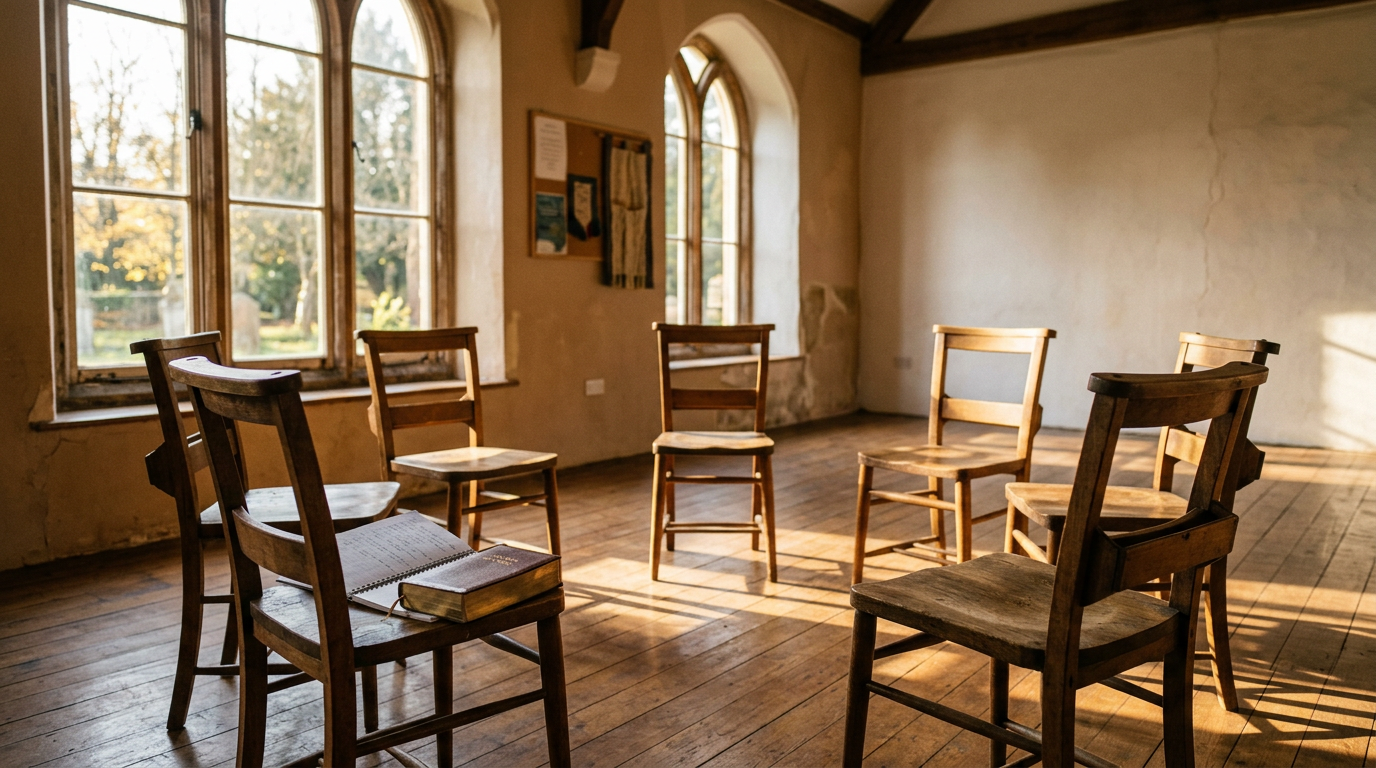
Someone in your congregation has just decided to be baptized. Now what?
In many churches the answer is a folder — a photocopied packet assembled years ago by someone who has since moved away, covering logistics, a testimony worksheet, and a paragraph on what the church believes. It is not bad. It is just thin. And it usually leaves the new believer with a clear picture of what will happen on Sunday and a foggy picture of why any of it matters.
A baptism class is one of the highest-leverage teaching opportunities a church has. The person in front of you is paying attention in a way they may not again for years. What you put in their hands now tends to shape how they read Scripture for a long time.
Here is a framework for building one that is genuinely grounded in the text.
Start With the Text, Not the Outline
The common failure mode is to write the outline first — five topics that feel like they belong in a baptism class — and then go hunting for verses to support each one. The result reads like a doctrinal statement with footnotes. It teaches conclusions without teaching anyone how to arrive at them.
Reverse the order. Choose the passages first. Let each session be built around a text the class reads together, and let the teaching emerge from what the passage actually says.
Begin with the commission itself:
“Go ye therefore, and teach all nations, baptizing them in the name of the Father, and of the Son, and of the Holy Ghost: Teaching them to observe all things whatsoever I have commanded you: and, lo, I am with you alway, even unto the end of the world. Amen.” — Matthew 28:19–20, KJV
Notice what is bundled together there. Baptizing and teaching are not sequential programs; they are one commission. A baptism class that only handles logistics has quietly dropped half of the verse it exists to obey.
A Four-Session Structure
Four sessions is enough to be substantive and short enough that people finish. Each session below is built around a primary passage, with a teaching aim and a discussion movement.
Session One: What Happened to Me?
Primary text: Romans 6:1–14.
“Therefore we are buried with him by baptism into death: that like as Christ was raised up from the dead by the glory of the Father, even so we also should walk in newness of life.” — Romans 6:4, KJV
The aim of this session is to connect baptism to the gospel rather than to the calendar. Paul is not describing a ceremony; he is describing a union with Christ that baptism pictures. Ask the group what “newness of life” would look like in an ordinary week — and let the answers be concrete.
Session Two: What Am I Joining?
Primary texts: Acts 2:37–47 and 1 Corinthians 12:12–27.
Baptism is not a private transaction. In Acts, the people baptized on that first day immediately appear in a list of shared practices: teaching, fellowship, breaking bread, prayer. New believers often arrive with a purely individual understanding of faith. This session gives them a body.
Session Three: How Do I Read This Book?
Primary texts: 2 Timothy 3:14–17 and Psalm 119:9–16.
This is the session most baptism classes leave out, and it is the one with the longest half-life. Teach a simple, repeatable method: read the passage, notice who is speaking and to whom, ask what it says about God, ask what it asks of the reader. Then do it together on a short psalm so nobody leaves with theory only.
Session Four: What Now?
Primary texts: Colossians 3:1–17 and Hebrews 10:19–25.
Close with practice. Prayer, gathering, generosity, confession, service. Send people out with a reading plan and a name — someone in the church who has agreed to check in on them.
Handle Denominational Questions Honestly
Baptism is one of the places where faithful Christians have long disagreed. Traditions differ on mode, on who is a proper subject, and on what precisely baptism accomplishes. Your class should teach your church’s position clearly — that is your responsibility as a leader — while being honest that other believers who love the same Scriptures read certain passages differently.
New believers are not fragile. What damages them is discovering later that a question was more contested than they were told, and wondering what else was smoothed over.
This is also where a generic study tool becomes a liability rather than a help. When someone in your class goes home and asks an AI assistant about infant baptism, they will get an answer averaged across every tradition at once. A study companion built to work within your specific theological tradition will explain how your church reads the text and can still describe the wider conversation fairly. Scripture remains the authority; the tool simply keeps the teaching consistent with what your congregation is being taught on Sunday.
Build the Materials Once, Then Reuse Them
Most churches rewrite this class every time because nothing from the last round was written down in a usable form. That is a solvable problem.
For each session you want three artifacts: a leader guide with the teaching aim and key observations, a participant handout with the passage and two or three questions, and a short take-home reading. Once those exist, the class becomes repeatable and delegable — which matters, because the pastor should not be the only person who can teach it.
Drafting those materials is exactly the kind of work that used to eat an entire week of evenings. Working from your chosen passages inside Gabriel, you can generate a first-pass small group guide for each session — discussion questions, application prompts, a summary for the leader — and then edit it into your own voice. The tool does the assembling; you do the pastoring. That is the right division of labor.
For churches with a shared workspace, the finished materials can live alongside your other ministry documents so the next person who teaches the class starts from what you built rather than from a blank page. A membership packet, a statement of faith, a previous curriculum — once those are in one searchable place, the guide you generate reflects what your church actually teaches instead of a generic template.
What About the Person Who Is Not Ready Yet?
Every baptism class eventually includes someone who signed up because a friend did, or because a parent asked, or because they felt something on a Sunday and are no longer sure what it was. Leaders often dread this and handle it by saying nothing.
Handle it directly instead, and handle it early. In the first session, say plainly that the class is a place to think, that nobody is obligated to continue, and that arriving at “not yet” is a legitimate outcome that will not embarrass anyone. That single sentence changes the room. It gives people permission to ask real questions rather than perform certainty.
Then give the uncertain person somewhere to go. A short reading plan through the Gospel of John, a standing invitation to keep meeting, and a specific person to talk with will do more than any amount of pressure. Faith that is talked into existence in a four-week class tends not to survive a hard year.
Keep the Follow-Up Simple
The weeks after a baptism are when most new believers quietly drift, usually not because of doubt but because nothing was scheduled. The fix is unglamorous: a plan and a person.
Send each participant home with a defined reading path for the next ninety days — short enough to finish, structured enough to build a habit. Pair them with someone in the congregation who will ask how it is going. And check in yourself at the thirty-day mark, when the novelty has worn off and the questions have gotten more honest.
Three Mistakes Worth Avoiding
Making it an information dump. If the class is a lecture, the new believer learns that faith is content to be received rather than a text to be engaged. Keep at least half of each session in the passage together.
Ending at the baptism. The commission says teaching them to observe, which is a long verb. Build the follow-up into the class itself rather than hoping it happens.
Skipping the hard questions. Someone will ask about assurance, or about a family member who was never baptized, or about whether they can lose what they have just received. Anticipate those and prepare an honest answer from Scripture rather than deflecting.
Start This Week
Pick your four passages. Write the teaching aim for each in a single sentence. Do that much and the rest of the class has somewhere to stand.
If you want help turning those passages into leader guides, handouts, and discussion questions your team can actually use, you can start a free trial of Gabriel and build your first session today.